




Child’s first visit to the dentist
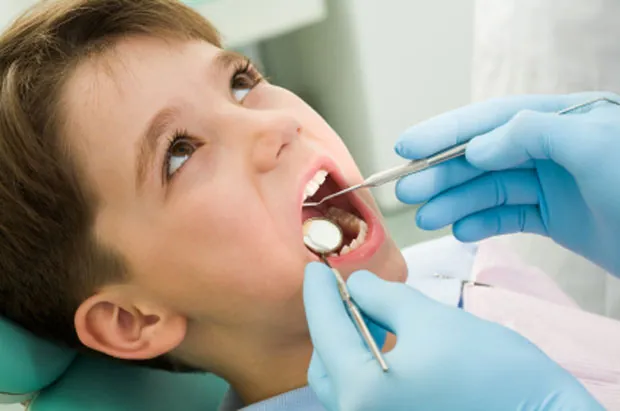
Take your three-year-old child to a check-up at the same time as you.
- Tell your child about the check-up and avoid making comments like: don’t be afraid, everything will be fine, be good, etc.
- Teach your child from a young age that visiting the dentist every six months is completely natural.
- Do not talk about pain and unpleasant things in front of your child.
- You do not need to show your child your courage by sitting in the dentist’s chair.
- Show your child your indifference with actions, not words.
- The dentist should become your child’s friend and the child should trust him.
Teeth of a six-year-old child:
The first permanent molar, the sixth, erupts behind the last deciduous molar. It is the most important tooth in the jaw. There are four of them.
Between the ages of six and nine, in addition to the eruption of the first permanent molar, the incisors also change. It happens that the permanent incisors erupt behind the deciduous teeth, while the deciduous teeth have not yet fallen out.
Between the ages of 9 and 12, the canine and premolar erupt.
As the permanent tooth grows, the root of the milk tooth is worn away (resorbed), disappears, but sometimes it can remain.
Sealing fissures or filling grooves
Research has shown that despite fluoridation, caries develops in them due to the special structure of the chewing surfaces of the molars. Therefore, in accordance with the doctor’s assessment, so-called sealing fissures are performed, i.e. filling the grooves on the chewing surfaces of the molars with prepared material. Thanks to the great efforts of dentists and prevention, children today have half as many damaged teeth as their parents.
The procedure is painless; after the tooth is cleaned, a special material is poured into the fissures of the permanent teeth, and all this takes a few minutes. Do you think we have solved the problem with this? No. A tooth does not have just one surface, it has five. We have only protected one surface of the tooth preventively, but the tooth should still be brushed well and regularly.
Should baby teeth be extracted and when
Baby teeth are extracted only if there is no room for permanent teeth to erupt. In most cases, baby teeth will fall out on their own.
Permanent teeth often erupt behind the baby teeth. During the eruption and change of teeth, various disorders in the placement of teeth can occur, so it is necessary to pay close attention to the course and change of teeth, so that timely intervention with therapy can be carried out.
